
- Release: 2016
- Designer: Gil Hova
- Artist: Heiko Günther, Travis Kinchy
- Publisher: Formal Ferret Games


Setup and Teaching
Even though the game takes up a lot of space, setting up is pretty simple, and the third section of the player board is a great help. There is one for each player count, and that shows you exactly what the setup is for that amount of players (including starting money).
The rulebook is well laid out and easy to read. The great thing is that the rules themselves are simple and not complex at all, so they’re easy to remember. The player boards have the list of actions you can do, which is also a great teaching aid. Everyone has understood the game by the end of round 1 (which is kind of a set-up round).
The Game
The aim of the game is to be the TV network with the most views. You have three time slots for shows, and you’ll develop shows and assign stars and adverts. Each show will have viewing numbers for four seasons (shows age at the end of each round) with varying amounts, although all will be on 1 or 2 in season 4.
Choosing the order to do things in is pretty important. When you develop a show, you will (usually) have to attach a star or ad (the show says which), but you can also attach others if there are slots available on the show. You can also replace stars/adverts, so you can develop a show with a poor star/ad and replace it later on. However, doing so will take up more turns and, after season 1, the reward gap between ending your season first and last is pretty significant (you can use an action to end your turn and take the money or viewer reward).
Shows, stars and adverts also have specific requirements, such as time slots or show genre. You can still attach any star/ad to any show (if a slot is available), but may have to rotate the card and get a much less effective bonus from them if you don’t meet the requirements.
The other important card type is Network Cards. You can use your action to pick one up. These are various special action cards. Some have an instant effect, one you can keep to use when you want, one is a permanent upgrade and some are end game bonuses. There are also three categories of Network Cards. Basic ones are regular ones, advanced are more complicated (you can throw them in after the first game) and interactive. The interactive cards are various ways to steal from other players (or mess with them), and I haven’t used them yet.
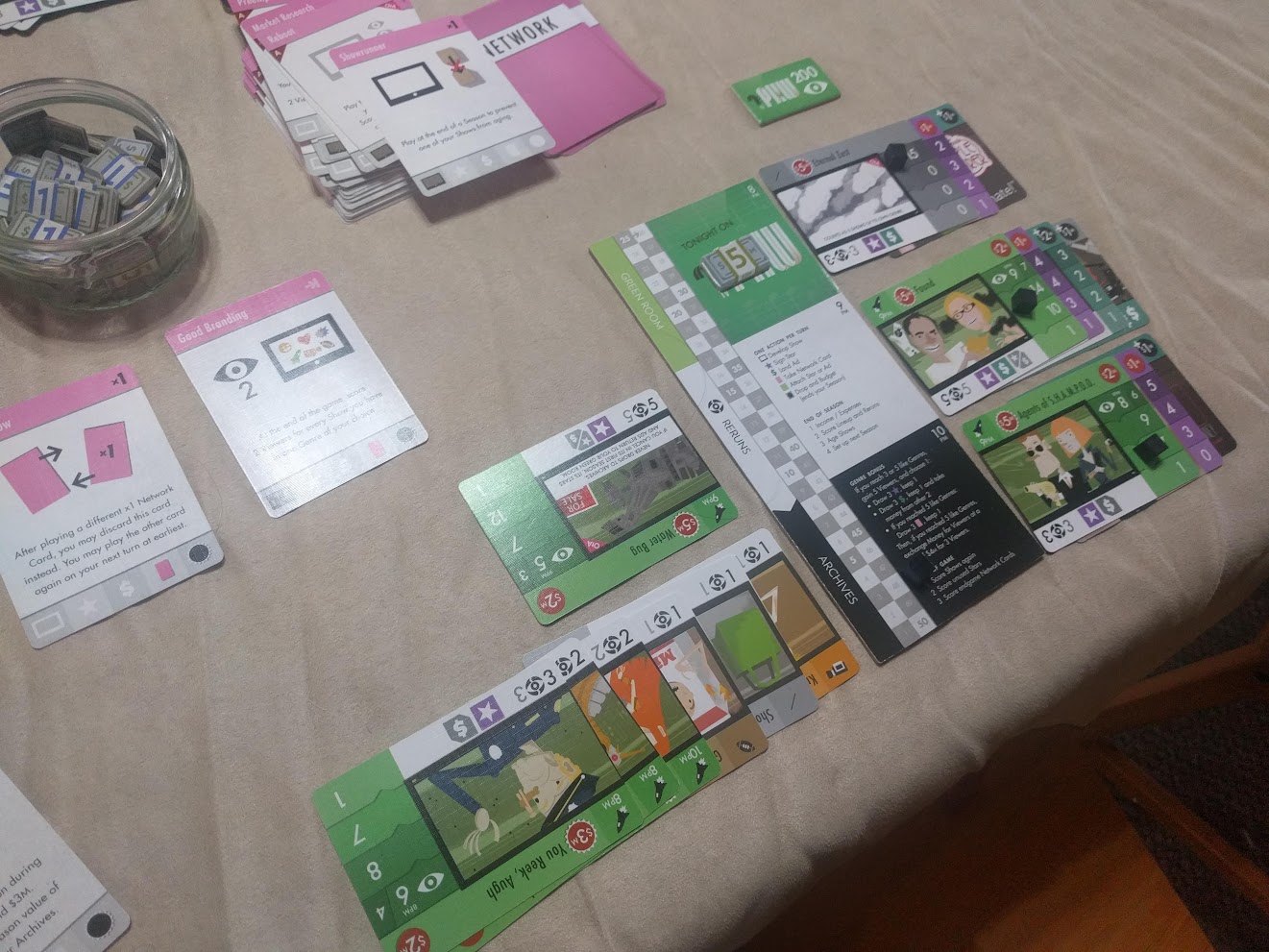
Components
The boards are a nice size with clear printing, one great thing with the player board is a score track to help you with scoring at the end of a season (there can be a lot of addition). The cards are really lovely linen cards and the artwork is great, with the card design extremely clear so you can tell the details of a cards with a quick glance. Every person who has played (and some who glanced at the game) have also pointed at the various different shows (they’re all parodies) with excitement. The colours of the score/player markers have also been picked really well (helping colourblind players like me). The box also has a lovely UV finish to make it look very swish.
Final Thoughts
Managing all the shows, stars and adverts is extremely entertaining and requires a lot of thought, and various different strategies. You have to be aware of what other players are after to judge what you can risk not picking up that turn. It’s also the kind of game where an early lead doesn’t mean victory – you can jump for points right from the start or you can build up to create a really strong late-game combination to take over the clear leaders in the final round.
Of course, this needs quite a few more plays before I give it a true score, but I can see this becoming one of my most often played games, and everyone I’ve played it (each time was with new people) would like to play it again. For now, I’ll give it a 9/10.

