
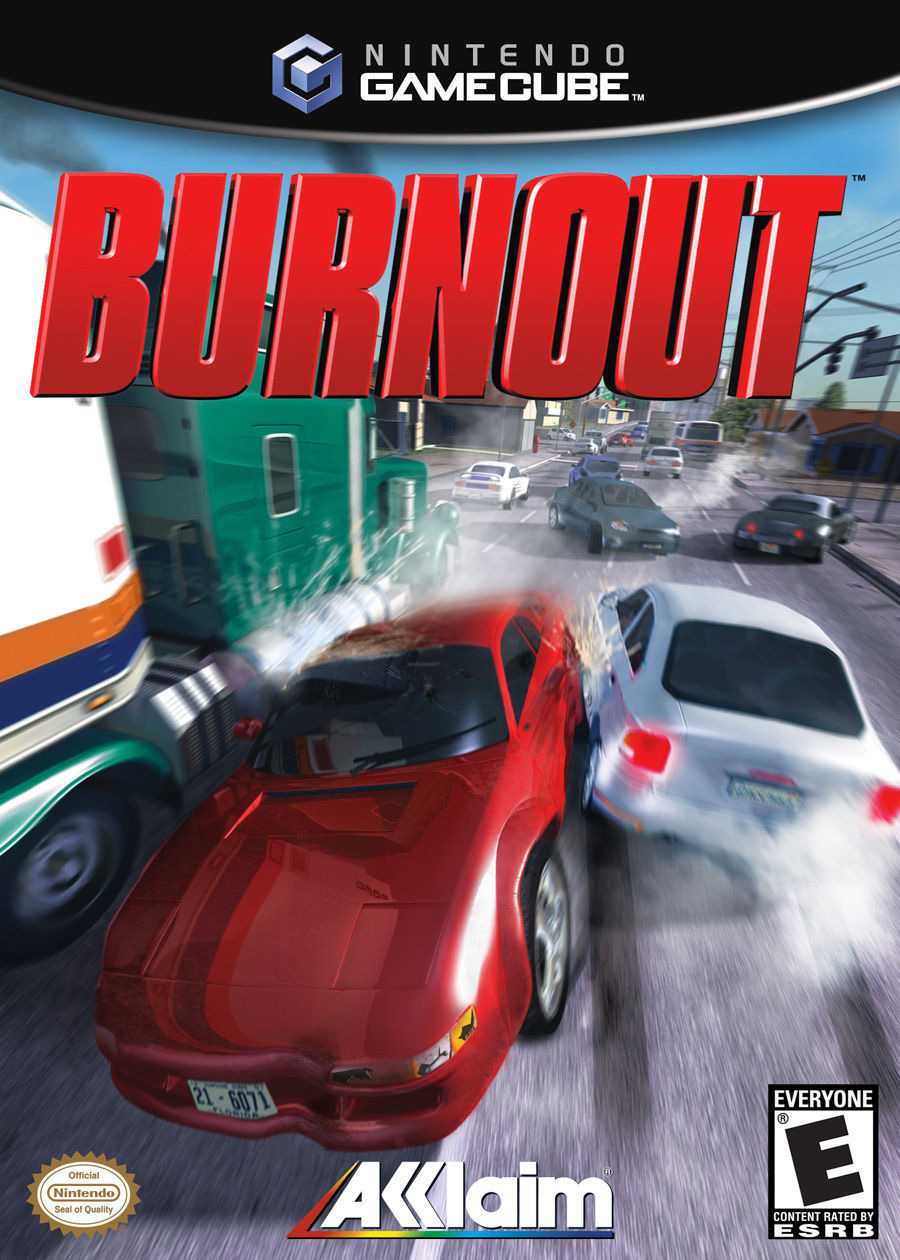
Race at breakneck speeds through packed city streets in this high adrenaline car racing game.
- NA release: 30th April 2002
- EU release: 3rd May 2002
- JP release: N/A
- Developer: Criterion
- Publisher: Acclaim
- NGC Magazine Score: 86%
- Mods Used: None


Burnout is my favourite racing franchise, and it all started with this game, which was quite likely my most played GameCube game as a kid. And while it may feel a bit more pedestrian now, due to many games having similar mechanics, it was also something quite unique when it came out. Burnout doesn’t just encourage you to drive dangerously, it’s required to do well at the game.

Burnout takes place in busy streets, with some tracks based on the USA and others based on Europe. There are only six distinct tracks in total, however, as the flow of traffic is so important, the reverse tracks really do feel quite different. There are also two epically long tracks that combine the three of each region together, making them feel like a connected area.
While the tracks themselves are nothing special, they look really nice for the time and have set traffic patterns that ramp up with each lap.

In order to win, you need to use your boost, however, your boost metre can only be filled by driving dangerously, by almost hitting other cards, drifting and driving on the wrong side of the road. You can only use your boost when fully charged, and if you let go before the bar is fully depleted, you have to charge it up again.
However, deplete the boost bar in a single go and you’ll automatically recharge half of your boost. If you do enough dangerous driving within this time, you’ll be able to continue boosting with an entire full bar. This means that taking risks at high speed is incredibly rewarding, as long as you don’t crash.

The time it takes between crashing and respawning could have easily been a massive flaw with the game, however the crashes themselves are satisfying, with all the card crumpling and distorting, and a tally of how much damage is caused is shown to you (which would become its own mode in later games). You can even save replays of your biggest crashes at the end of a race to watch in more detail.
Going back to the original Burnout after later ones, it definitely feels more muted (the sound effects particularly aren’t as strong), but the deformation is still great.

While Burnout definitely improved in later games, the original is still a great game, with extremely satisfying racing and the traffic junctions greatly enhancing the tracks. You can even unlock a bus for a bit of extra challenge. There are loads of nice additional touches, such as your car indicating before turns and the AI racers making mistakes and crashing, which was really nice to see.
Burnout was also my introduction to the now standard way of controlling racing games: using the left and right analogue shoulder buttons for acceleration and braking. It doesn’t seem like much now, but it was a big change to using A and B.

Fave
Just as you’d hope, it all works wonderfully. This system pushes players to take more risks on the road, as the more near-misses and insane cornering manoeuvres you pull off, the faster you’re able to go. The thrilling experience of successfully weaving your way through a packed tunnel before skidding through a crossroads and into first place is thrilling to say the least, and it’s perhaps for this reason more than any other that we enjoyed Burnout so much.
Geraint Evans, NGC Magazine #67
Remake or remaster?
A remastered collection is very much needed. I’d love one that lets you mix and match the modes, features and gameplay styles of the first three games.
Official Ways to get the game
There is no official way to get Burnout.
Europe

Japan
North America


GameCube Games by Date
2002: Jan, Feb, Mar, Apr, May, Jun, Jul, Aug, Sep, Oct, Nov, Dec
2003: Jan, Feb, Mar, Apr, May, Jun, Jul, Aug, Sep, Oct, Nov, Dec
2004: Jan, Feb, Mar, Apr, May, Jun, Jul, Aug, Sep, Oct, Nov, Dec
2005: Jan, Feb, Mar, Apr, May, Jun, Jul, Aug, Sep, Oct, Nov, Dec
2006: Jan, Feb, Mar, Apr, May, Jun, Jul, Aug, Sep, Oct, Nov, Dec


Hell yeah! Burnout is the real shit! 😀
I’m still bitter that 3 and Revenge never came to Gamecube… What a tragedy.
An even bigger tragedy is how EA killed the series as a whole… and the engine that powered both it and the grand majority of the entire 6th generation of consoles, the mighty RenderWare.
Burnout was the first in-house game that utilised the engine, and was Criterion’s first ever commercial video-game project; they were previously a division of Canon (yes, the camera manufacturer), and RenderWare started out as a suite of CAD software. It was only in the late 90s that RenderWare started being retooled into a video game engine; directly in response to Argonaut’s B-Render engine. And while Criteron did put out a demo game (CyberStreet) for developers to base their games off of, Burnout was the first in-house commercial game to use the first finished release version of the engine that we know today as RenderWare.
And what an engine it was! It powered no less than 300 games! Including literally the biggest series of the entire generation, none other than Grand Theft Auto 3/VC/SA. RenderWare was highly versatile, very well documented and very performant. Even Japanese developers made heavy use of the engine; as seen in games like Sonic Heroes and Persona 3/4. Unlike modern middleware engines such as Unity and Unreal, which offer complete all-in-one solutions, Renderware was more of a malleable set of tools that could form the basis of any given game engine. But it was fast, and its malleable nature meant that it could be used for any type of game. When developers saw what Criterion were pulling off with Burnout? It quickly became the industry standard thereafter.
If Gears of War was the game that sold Unreal Engine 3 in the PS360 era? Burnout was that same game for RenderWare on the GCN/PS2/Xbox.
But Burnout happened to be more than just a fantastic tech demo, it also happened to be a BANGING arcade racing game! An utterly simple and brilliant concept (drive dangerously to win!), executed perfectly! The concept literally sells itself!
It would of course go on to produce bigger and better sequels, but Burnout is one of the single most important games of the entire generation, because it sold the engine that powered it by proving its worth to developers around the world. Without Burnout, there is no GTA 3.
An engine so powerful that EA bought out the studio and their tools, in order to kill it off.
Burnout was great on the GameCube 😀
It felt pretty fresh at the time and everything was even better with Point of Impact!
I would definitely have been interested in picking up Burnout 3: Takedown if it came to GameCube but sadly it wasn’t to be and, as such, I haven’t ever really played it. I do own it now on PS2 but actually only recently took a notion to play it. Unfortunately, the image was so blurry that it was practically impossible to play 😕
I never had much interest in the series beyond that as, like with everything, they seemed to take it further and further away from what made it great.
I picked up Burnout Paradise on sale for Switch a few years ago and, while I ended up beating it, I wasn’t much of a fan of it at all.
I never liked the open nature of it and feel like the racing, course design and variety of environments all suffer because of it.
Hopefully Mario Kart World will be OK in this regard but it certainly seems like it’ll be more than OK!
If Mario Kart World can be half as good as Burnout Paradise, it will be a phenomenal game. That said, the main features I loved about Paradise back then (the online) are why I’ll probably not touch MK World.
If Mario Kart World is only half as good as Burnout Paradise, I’ll never play another game again 😂